
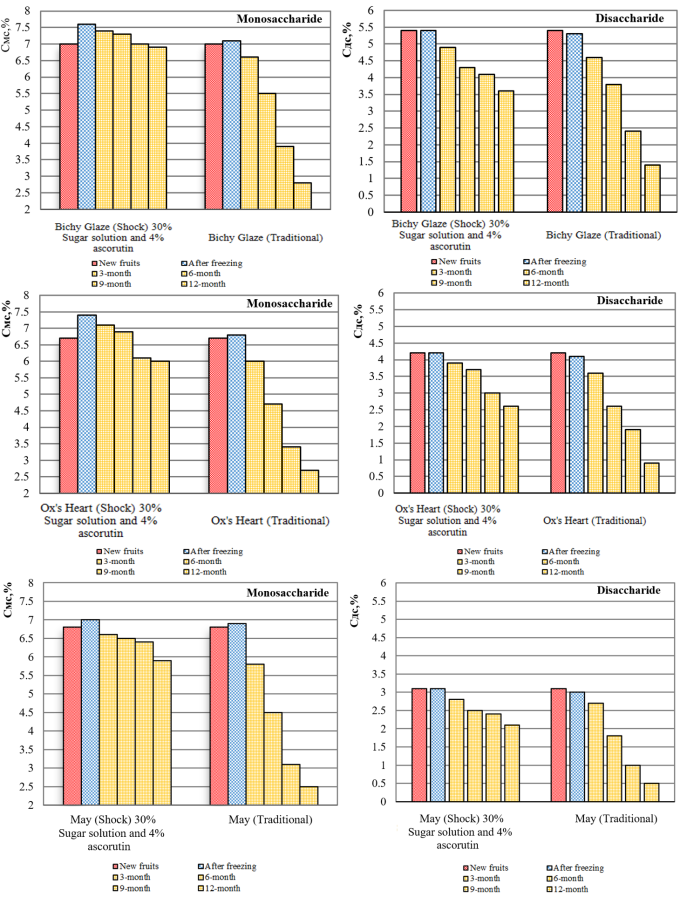
Today, the demand for fruits and vegetables rich in natural vitamins, micro-and macroelements is increasing. Of great importance is the improvement of the technology of freezing, which, along with natural mono-and disaccharides in fruits, determine the specific taste, preserve organic acids in moderation. In the Food Industry, Scientific Research is being carried out on the preservation of fruits and vegetables on the basis of high-quality and energy-efficient technologies. In this regard, special attention is paid to the development of technologies for storing fruits rich in basic color, vitamins and minerals when freezing in a traditional and shock way. Many scientists have carried out scientific research on the improvement of technologies for freezing and storing fruits and vegetables. Improved technologies have been developed by them to reduce the degree of their oxidation during the period of storage of fruits in freezing chambers after washing and sorting-up to 6-9 months of freezing 10-15°C, the speed and type of cooling agent to the duration of the process, processing of products with citric acid or ascorbic acid in freezing. Solutions to the problem: 1. It has been proven that after shock freezing of selected cherry samples and storage for 6 months, a 2% increase in soluble solids, a 2-fold decrease in the amount of tannins. 2. After processing with 30% sugar syrup and 4% ascorutin, it has been proven that sugar content in shock frozen cherries is maintained in maximum quantities for 10-12 months. 3. The impact of the shock freezing and storage period on the chemical composition of cherries, mono-and disaccharides, ascorbic acid, acidity indicators are determined. 4. The process duration of freezing is reduced, improved technology has been developed, which uses an environmentally friendly cooling agent. Based on the conclusion of the studies carried out, it was experimentally determined that cherries as a suitable variety are the Beech glaze variety. Samples treated with shock-frozen 30% sugar syrup and 4% ascorutin were found to have the property of storing mono-and disaccharide levels within themselves for up to 9 months. Ascorbic acid levels of up to 87% and 74% of sugars were found to be between 62% and 42% during storage periods. As a result of freezing, a change in organoleptic indicators, color, texture in Cherries was analyzed.
| Published in | World Journal of Agricultural Science and Technology (Volume 4, Issue 1) |
| DOI | 10.11648/j.wjast.20260401.12 |
| Page(s) | 10-15 |
| Creative Commons |
This is an Open Access article, distributed under the terms of the Creative Commons Attribution 4.0 International License (http://creativecommons.org/licenses/by/4.0/), which permits unrestricted use, distribution and reproduction in any medium or format, provided the original work is properly cited. |
| Copyright |
Copyright © The Author(s), 2026. Published by Science Publishing Group |
Fruit, Cherry, Shock Freezing, Cooling Agent, Temperature, Mono and Disaccharides
№ | Name of the species | Glucose,% | Fructose,% | Sucrose,% |
|---|---|---|---|---|
1 | May | 2,70 | 2,65 | 0,15 |
2 | Bull's eye | 3,74 | 3,04 | 0,42 |
3 | Ox heart | 2,90 | 2,75 | 0,44 |
Name of the variety | Amount of sugar,% | |||||||||||
|---|---|---|---|---|---|---|---|---|---|---|---|---|
New fruits | After freezing | month | ||||||||||
3 | 6 | 9 | 12 | |||||||||
МS | DS | МS | DS | МS | DS | МS | DS | МS | DS | МS | DS | |
May | 5,6 | 0,26 | 5,8 | 0,25 | 5,5 | 0,17 | 5,4 | 0,09 | 6,3 | 0,06 | 5,2 | 0,04 |
Bull's eye | 6,3 | 0,22 | 7,0 | 0,21 | 6,6 | 0,18 | 6,4 | 0,09 | 6,3 | 0,04 | 6,2 | 0,04 |
Ox heart | 6,0 | 0,42 | 6,9 | 0,38 | 6,5 | 0,26 | 6,2 | 0,18 | 6,1 | 0,07 | 5,9 | 0,02 |
MS | Monosaccharides |
DS | Disaccharides |
| [1] | Aripov M. M., Mamatov Sh. M., Ergasheva Z. K. Study of Shock Freezing Modes for Agricultural Products. Current Issues in Humanitarian and Natural Sciences. Journal of Scientific Publications. – Moscow, 2018. – No. 6. – Pp. 27–28. |
| [2] | Aripov M. M. Shock Freezing Technology for Berries. “Agency for International Research-2016” New Science: From Idea to Result, International Scientific and Practical Conference, 3-volume. Surgut, 2016. – Pp. 17–19 |
| [3] |
Aripov M. M. Technology shock freezing fruits. “National Association of Scientists-2016” “The Role of Science in the Development of Society: Theoretical and Practical Aspects” XXII International Scientific and Practical Conference – Moscow, 2016. –pp. 100–101.
https://cyberleninka.ru/article/n/technology-shock-freezing-fruits/viewer |
| [4] | Aripov M. M., Mamatov Sh. M. Kadirov U. R., Turobjonov S. M., Mannanov U. V. The using Infrared Radiation on the Freeze-Drying of Cherry. Scopus: International Journal of Innovative Technology and Exploring Engineering (IJITEE). Published By: Blue Eyes Intelligence Engineering & Sciences Publication, Volume-9 Issue-2, December 2019 –pp. 1628-1629. |
| [5] | Aripov M. M., Mamatov Sh. M. Meliboev M., Shamsutdinov B. Advantages of Quick-Freezing Technology of Cherry. Scopus: International Journal of Innovative Technology and Exploring Engineering (IJITEE), Volume-9 Issue-3, January 2020 –pp. 3254-3256. |
| [6] | Korotkiy I. A. Analysis of the energy efficiency of the fast freezing of blackcurrant berries // Foods and Raw Materials. – 2014. – No. 2. – pp. 3–14. |
| [7] | Kutsakova V. E., Frolov S. V., Yakovleva M. I. Mass transfer during freezing. Russian journal of applied chemistry. 1997. V. 70, no. 12, pp. 2061–2063. |
| [8] | Yusupbekov N. R., Nurmukhamedov Kh. S., Ismatullayev P. R., Zokirov S. G., Mannonov U. V. Calculations and design of the main processes and devices of the chemical and food industries. – Tashkent: Sharq, 2000. – 231 p. |
| [9] | Yusupbekov N. R., Nurmukhamedov Kh. S. Calculations and examples of the processes and devices of the chemical and food industries. – Tashkent, 1999. – 351 p. |
| [10] | Kutsakova V. Ye., Utkin Yu. V., Frolov C. B., Tretyakov H. A. Raschet vremeni zamorajivaniya beskonechnogo silindra i shara s uchetom odnovremennogo oxlajdeniya zamorojennoy chasti // Xolodilnaya texnika. 1996. –№ 2. –21c. |
| [11] | Borisova, A. V., Makarova N. V. Effect of storage duration on the chemical composition and antioxidant properties of fresh and frozen vegetables // News of higher educational institutions. Food technology. 2013. - No. 2-3. - P. 36-38. |
| [12] | Balikova L. I., Yurkov Yu. A., Rogonayev M. V. Use of nitrogen for freezing senescent hydrobionts // Proceedings of the International Conference Cold Industry in the XXI Century. 2004. - P. 116-119. |
| [13] |
Aripov M. M., Ko’palova. M The effect of freezing methods on the textural parameters of cherry fruit samples during different storage periods. XXXIV Republican Scientific and Technical Conference of Master's and Bachelor's Students PROMISING CHEMISTS-2025 dedicated to the year of "Environmental Protection and Green Economy" COLLECTION OF ARTICLES Tashkent-2025 B62-64
https://tkti.uz/en/news/detail/toshkexnologistitutida-umidli-kimy/ |
| [14] |
Aripov M. M., Norov. H. Changes in physical properties of cherries during freezing and color values during freezing periods. XXXIV Republican Scientific and Technical Conference of Master's and Bachelor's Students PROMISING CHEMISTS-2025 Dedicated to the Year of "Environmental Protection and Green Economy" COLLECTION OF ARTICLES Tashkent-2025 B59-61.
https://tkti.uz/en/news/detail/toshkexnologistitutida-umidli-kimy/ |
| [15] |
Aripov M. M., Mamatov. SH., Niyozov. X. Alternative indicators of temperature and air flow rate in the rapid freezing of cherry fruits. Universal journal of technology and innovation/ VOLUME 1. ISSUE 7. November Tashkent-2023. P. 37-45.
https://www.academia.edu/116152696/Universal_journal_of_technology_and_innovation |
APA Style
Aripov, M., Berdiev, S., Ziyoyev, A., Shokirov, A., Mamatov, S. (2026). Improving the Technology of Pre-processing and Freezing Cherries. World Journal of Agricultural Science and Technology, 4(1), 10-15. https://doi.org/10.11648/j.wjast.20260401.12
ACS Style
Aripov, M.; Berdiev, S.; Ziyoyev, A.; Shokirov, A.; Mamatov, S. Improving the Technology of Pre-processing and Freezing Cherries. World J. Agric. Sci. Technol. 2026, 4(1), 10-15. doi: 10.11648/j.wjast.20260401.12
@article{10.11648/j.wjast.20260401.12,
  author = {Mirolim Aripov and Sherzodbek Berdiev and Axror Ziyoyev and Asliddin Shokirov and Sherzod Mamatov},
  title = {Improving the Technology of Pre-processing and Freezing Cherries},
  journal = {World Journal of Agricultural Science and Technology},
  volume = {4},
  number = {1},
  pages = {10-15},
  doi = {10.11648/j.wjast.20260401.12},
  url = {https://doi.org/10.11648/j.wjast.20260401.12},
  eprint = {https://article.sciencepublishinggroup.com/pdf/10.11648.j.wjast.20260401.12},
  abstract = {Today, the demand for fruits and vegetables rich in natural vitamins, micro-and macroelements is increasing. Of great importance is the improvement of the technology of freezing, which, along with natural mono-and disaccharides in fruits, determine the specific taste, preserve organic acids in moderation. In the Food Industry, Scientific Research is being carried out on the preservation of fruits and vegetables on the basis of high-quality and energy-efficient technologies. In this regard, special attention is paid to the development of technologies for storing fruits rich in basic color, vitamins and minerals when freezing in a traditional and shock way. Many scientists have carried out scientific research on the improvement of technologies for freezing and storing fruits and vegetables. Improved technologies have been developed by them to reduce the degree of their oxidation during the period of storage of fruits in freezing chambers after washing and sorting-up to 6-9 months of freezing 10-15°C, the speed and type of cooling agent to the duration of the process, processing of products with citric acid or ascorbic acid in freezing. Solutions to the problem: 1. It has been proven that after shock freezing of selected cherry samples and storage for 6 months, a 2% increase in soluble solids, a 2-fold decrease in the amount of tannins. 2. After processing with 30% sugar syrup and 4% ascorutin, it has been proven that sugar content in shock frozen cherries is maintained in maximum quantities for 10-12 months. 3. The impact of the shock freezing and storage period on the chemical composition of cherries, mono-and disaccharides, ascorbic acid, acidity indicators are determined. 4. The process duration of freezing is reduced, improved technology has been developed, which uses an environmentally friendly cooling agent. Based on the conclusion of the studies carried out, it was experimentally determined that cherries as a suitable variety are the Beech glaze variety. Samples treated with shock-frozen 30% sugar syrup and 4% ascorutin were found to have the property of storing mono-and disaccharide levels within themselves for up to 9 months. Ascorbic acid levels of up to 87% and 74% of sugars were found to be between 62% and 42% during storage periods. As a result of freezing, a change in organoleptic indicators, color, texture in Cherries was analyzed.},
 year = {2026}
}
TY  - JOUR
T1  - Improving the Technology of Pre-processing and Freezing Cherries
AU  - Mirolim Aripov
AU  - Sherzodbek Berdiev
AU  - Axror Ziyoyev
AU  - Asliddin Shokirov
AU  - Sherzod Mamatov
Y1  - 2026/04/23
PY  - 2026
N1  - https://doi.org/10.11648/j.wjast.20260401.12
DO  - 10.11648/j.wjast.20260401.12
T2  - World Journal of Agricultural Science and Technology
JF  - World Journal of Agricultural Science and Technology
JO  - World Journal of Agricultural Science and Technology
SP  - 10
EP  - 15
PB  - Science Publishing Group
SN  - 2994-7332
UR  - https://doi.org/10.11648/j.wjast.20260401.12
AB  - Today, the demand for fruits and vegetables rich in natural vitamins, micro-and macroelements is increasing. Of great importance is the improvement of the technology of freezing, which, along with natural mono-and disaccharides in fruits, determine the specific taste, preserve organic acids in moderation. In the Food Industry, Scientific Research is being carried out on the preservation of fruits and vegetables on the basis of high-quality and energy-efficient technologies. In this regard, special attention is paid to the development of technologies for storing fruits rich in basic color, vitamins and minerals when freezing in a traditional and shock way. Many scientists have carried out scientific research on the improvement of technologies for freezing and storing fruits and vegetables. Improved technologies have been developed by them to reduce the degree of their oxidation during the period of storage of fruits in freezing chambers after washing and sorting-up to 6-9 months of freezing 10-15°C, the speed and type of cooling agent to the duration of the process, processing of products with citric acid or ascorbic acid in freezing. Solutions to the problem: 1. It has been proven that after shock freezing of selected cherry samples and storage for 6 months, a 2% increase in soluble solids, a 2-fold decrease in the amount of tannins. 2. After processing with 30% sugar syrup and 4% ascorutin, it has been proven that sugar content in shock frozen cherries is maintained in maximum quantities for 10-12 months. 3. The impact of the shock freezing and storage period on the chemical composition of cherries, mono-and disaccharides, ascorbic acid, acidity indicators are determined. 4. The process duration of freezing is reduced, improved technology has been developed, which uses an environmentally friendly cooling agent. Based on the conclusion of the studies carried out, it was experimentally determined that cherries as a suitable variety are the Beech glaze variety. Samples treated with shock-frozen 30% sugar syrup and 4% ascorutin were found to have the property of storing mono-and disaccharide levels within themselves for up to 9 months. Ascorbic acid levels of up to 87% and 74% of sugars were found to be between 62% and 42% during storage periods. As a result of freezing, a change in organoleptic indicators, color, texture in Cherries was analyzed.
VL  - 4
IS  - 1
ER  -
Department of Biotechnology, Tashkent Chemical-Technological Institute, Tashkent, Uzbekistan
Biography: Mirolim Aripov is an associate professor of the Department of Biotechnology of the Tashkent Institute of Chemical Technology. Having completed his bachelor's degree in 2011, he was accepted to study for a master's degree in the specialty of Food Technology (Fat Processing Technology) at the Faculty of "Food Products Technology" of the Tashkent Institute of Chemical Technology and, having completed the master's degree in 2013, in March 2023 he defended his dissertation for the degree of Doctor of Philosophy in Technical Sciences on the topic "Improvement of the technology of freezing cherries" and received the scientific degree of Doctor of Philosophy in Technical Sciences on May 5, 2023. technical committees at international conferences.
Research Fields: Mirolim Aripov is an associate professor of the Department of Biotechnology of the Tashkent Institute of Chemical Technology. Having completed his bachelor's degree in 2011, he was accepted to study for a master's degree in the specialty of Food Technology (Fat Processing Technology) at the Faculty of "Food Products Technology" of the Tashkent Institute of Chemical Technology and, having completed the master's degree in 2013, in March 2023 he defended his dissertation for the degree of Doctor of Philosophy in Technical Sciences on the topic "Improvement of the technology of freezing cherries" and received the scientific degree of Doctor of Philosophy in Technical Sciences on May 5, 2023. technical committees at international conferences.

Department of Biotechnology, Tashkent Chemical-Technological Institute, Tashkent, Uzbekistan
Biography: Sherzodbek Berdiev — Assistant Professor of the Department of Technological Processes and Devices Design of the Tashkent Institute of Chemical Technology After completing his bachelor's degree in 2019, he was admitted to the master's degree program in Chemical Technology Processes and Devices (for the production of inorganic and organic substances) at the Faculty of Chemical Engineering of the Tashkent Institute of Chemical Technology, and after completing his master's degree in 2021, in September 2025 he defended his dissertation for the degree of Doctor of Philosophy in Technical Sciences on the topic "Obtaining and practical application of permutite for the treatment of industrial wastewater and irrigation water", and on October 31, 2025 he received the degree of Doctor of Philosophy in Technical Sciences.
Research Fields: Sherzodbek Berdiev — Assistant Professor of the Department of Technological Processes and Devices Design of the Tashkent Institute of Chemical Technology After completing his bachelor's degree in 2019, he was admitted to the master's degree program in Chemical Technol-ogy Processes and Devices (for the production of inorganic and organic substances) at the Faculty of Chemical Engineering of the Tashkent Institute of Chemical Technology, and after completing his master's degree in 2021, in September 2025 he defended his dissertation for the degree of Doctor of Philosophy in Technical Sciences on the topic "Obtaining and practical application of permutite for the treatment of in-dustrial wastewater and irrigation water", and on October 31, 2025 he received the degree of Doctor of Philosophy in Technical Sciences.

Department of Biotechnology, Tashkent Chemical-Technological Institute, Tashkent, Uzbekistan
Biography: Axror Ziyoyev is an assistant professor at the Department of Engineering Fundamentals and Mechanics of the Tashkent Institute of Chemical Technology. After completing his bachelor's degree in 2019, he was accepted to study for a master's degree in the specialty of food industry machines and units at the Faculty of "Food Technology" of the Tashkent Institute of Chemical Technology, and after completing his master's degree in 2021, from September 6, 2021 to the present, he has been working as an assistant professor at the Department of Engineering Fundamentals and Mechanics of the Faculty of Industrial Engineering and Management. In recent years, he has participated in many international scientific cooperation projects.
Research Fields: Axror Ziyoyev is an assistant professor at the Department of Engineering Fundamentals and Mechanics of the Tashkent Institute of Chemi-cal Technology. After completing his bachelor's degree in 2019, he was accepted to study for a master's degree in the specialty of food in-dustry machines and units at the Faculty of "Food Technology" of the Tashkent Institute of Chemical Technology, and after completing his master's degree in 2021, from September 6, 2021 to the present, he has been working as an assistant professor at the Department of Engi-neering Fundamentals and Mechanics of the Faculty of Industrial Engineering and Management. In recent years, he has participated in many international scientific cooperation projects.

Department of Biotechnology, Tashkent Chemical-Technological Institute, Tashkent, Uzbekistan
Biography: Asliddin Shokirov, 2019 - May - Listener of the Institute for the Study of Youth Problems and Training of Promising Personnel under the Academy of Public Administration under the President of the Republic of Uzbekistan. 2019 – 2020 - Assistant "Deputy" of the Department of "Technological Processes and Devices" of the Tashkent Institute of Chemical Technology. 2021 – 2024 - Deputy Dean for Academic Affairs of the Faculty of Food Technology of the Tashkent Institute of Chemical Technology. 2024 - 2025 - Assistant "Deputy" of the Department of "Engineering Fundamentals and Mechanics" of the Tashkent Institute of Chemical Technology. 2024 - present - Manager of the Database Department of the "Registrar's Office" of the Tashkent Institute of Chemical Technology
Research Fields: Asliddin Shokirov, 2019 - May - Listener of the Institute for the Study of Youth Problems and Training of Promising Personnel under the Academy of Public Administration under the President of the Republic of Uzbekistan. 2019 – 2020 - Assistant "Deputy" of the Department of "Technological Processes and Devices" of the Tashkent Institute of Chemical Technology. 2021 – 2024 - Deputy Dean for Academic Affairs of the Faculty of Food Technology of the Tashkent Institute of Chemical Technology. 2024 - 2025 - Assistant "Deputy" of the De-partment of "Engineering Fundamentals and Mechanics" of the Tashkent Institute of Chemical Technology. 2024 - present - Manager of the Database Department of the "Registrar's Office" of the Tashkent Institute of Chemical Technology.

Department of Managment, Webster University, Tashkent, Uzbekistan
Biography: Sherzod Mamatov is the Deputy Director of Webster University in Tashkent. He graduated from the bachelor's degree in 2008 and the master's degree in 2010. In 2010, he was accepted to the Food Safety Department of the Tashkent Institute of Chemical Technology for postgraduate study. In 2014, he was accepted to the Internship Research Institute of the Tashkent Institute of Chemical Technology and in July 2015, he successfully defended his doctoral thesis on the topic "Improvement of drying technology of agricultural products". Since August 2020, he has been working as the 1st Deputy Director of Webster University in Tashkent. He has published more than 120 scientific works and 4 students have received the degree of Doctor of Philosophy in technical sciences. In recent years, he has participated in many international scientific cooperation projects.
Research Fields: Sherzod Mamatov is the Deputy Director of Webster University in Tashkent. He graduated from the bachelor's degree in 2008 and the master's degree in 2010. In 2010, he was accepted to the Food Safety Department of the Tashkent Institute of Chemical Technology for postgraduate study. In 2014, he was accepted to the Internship Research Institute of the Tashkent Institute of Chemical Technology and in July 2015, he successfully defended his doctoral thesis on the topic "Improvement of drying technology of agricultural products". Since August 2020, he has been working as the 1st Deputy Director of Webster University in Tashkent. He has published more than 120 scientific works and 4 students have received the degree of Doctor of Philosophy in technical sciences. In recent years, he has participated in many international scientific cooperation projects.


Information



 Share This Article
 Twitter
 Linked In
 Facebook
 Copy
Copy Download